evosis
  • Home
  • Courageous Inclusion
  • Transformational Coaching
  • About
  • Contact
  • Home
  • Courageous Inclusion
  • Transformational Coaching
  • About
  • Contact
Search by typing & pressing enter

YOUR CART

Blog

27/4/2024 0 Comments

Leadership and Organisational Authenticity

From the Archives: June 2013
 
I have recently been integrating authentic leadership more frequently in my practice.  This has prompted me to consider what does authenticity really mean?  What does it mean for me as a leader? What does it mean for leadership development and organisation development / culture change?  
 
Authentic Leadership is about aligning who you are with what you do.  This includes congruence and integrity as well as; 
  • Balanced processing (objectivity in decision making)
  • Internalized moral perspective (standards and ethics which regulate behaviour) 
  • Relational transparency (openly sharing appropriate information and feelings)
  • Self-awareness (demonstrate an understanding of your own strengths and weaknesses) 
Picture

 
At a basic level for many of the leaders I work with Authenticity means finding ways to agree with the ‘corporate messages’ they need to communicate.  Finding a way to believe that the change is a positive move and empathising with their senior leaders’ choice.  Thus changing their attitudes and emotions so their behaviours can be congruent.  However is this enough? Also what does this mean for corporate culture change?
 
We all flex our external selves when we choose to share some parts of our personality in some circumstances whilst hiding or ‘muting’ others.  For example we all have roles we take on where we are different versions of ourselves e.g. worker, leader, mother, sister, friend, colleague etc.  But how much is it appropriate to share our underlying assumptions of our personal selves when in our work roles and vice versa?  What parts of you are your essence and therefore need to be reflected in everything you do and which parts are more surface, flexible elements of your persona which can flex or be ‘hidden’ in certain circumstances?  Generation X (Baby boomers) and even Y (Millennials) have traditionally kept their work and personal life separate, generation Z (Digital natives) however almost have no choice but to have them intertwined.  This feels wrong for many of us but perhaps it’s just much more authentic…? So authenticity as a leader requires considerable self awareness and the willingness to share experience.
 
Authentic Teams
In the past we have been conditioned to segregate parts of our ‘selves’ in some circumstances because of fear of discrimination or being treated differently.  Social identity theory can be described as “a person’s sense of who they are based on their group memberships”.  These groups such as family, social class, nationality, religion, sexuality, profession and even the football team you support provide us with a sense of belonging as well as ‘out-group’ discrimination of people who are not part of your group.  People ‘self categorise’ into groups based on their ‘positive distinctiveness’.  Our social identity is very much entwined with how we live, make money, relax, who we socialise with, our upbringing, where we live, our family and relationships.  Identity is important because it creates vulnerability to discrimination based on your membership of (particularly minority) groups. Building team authenticity requires a delicate balance between team identity and valuing 'out' groups for their diversity.
 
Organisational Authenticity
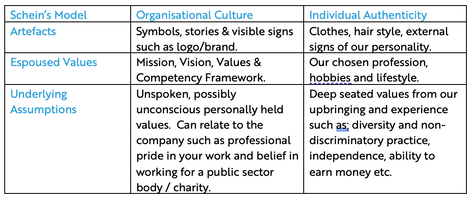
Whilst considering individual belief changes, I began to realise that your behaviours and attitudes can flex and adapt but to remain authentic they need to be rooted in a core of your personality, who you are.  There are some things that you can’t flex or compromise on, the things that together make you and individual.  Following this train of thought reminded me of Schein’s model of organisational culture.  If this applies to organisations maybe it also applies to the individual as illustrated in the table below.
​
 
Based on this model our artefacts and even espoused values are likely to flex, however underlying assumptions may be held so strongly and potentially unconsciously we are not likely to want to change these.  It also underlines the importance of choosing appropriate change goals when considering organisational culture to create authentic organisational change.


How do you define and practice authenticity? Who are you?  What’s your story? I’d be really interested to hear other people’s views of this so please comment below!
 
I have recently been integrating authentic leadership more frequently in my practice.  This has prompted me to consider what does authenticity really mean?  What does it mean for me as a leader? What does it mean for leadership development, teams and organisation development / culture change? 


0 Comments


Leave a Reply.

    Al Pacifico-France

    I write about my experiences and identities in an organisational context. My writing is intended to empower and inspire others to achieve transformations with the goals of improving business performance and social justice. 

    Topics covered generally include leadership, team working and diversity, equity, inclusion and belonging. 

    Picture
Copyright © 2025